Freddie Spencer, and the record that will never be broken.
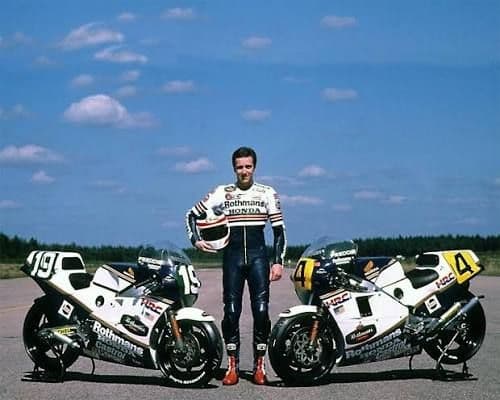
Three champions: the 1984 NSR 500, Freddie Spencer, and the 1984 NSR 250.
Whether you are or aren't a sports fan, you must admit professional competition has written stories that transcend their boundaries and become part of general history. The type of events and accomplishments that burn into one's memory, whether they like that sport or not. Think of the 1972 Miami Dolphins going 17–0; Franz Klammer’s wild downhill run, the steroid-fueled home run race, early Mike Tyson, etc. Motorcycle racing, being a niche sport, usually gets overlooked among mainstream sports. But there is a story from motorcycle racing that clearly belongs on that list. It is the most unique, and one of the most incredible, achievements in all sports: Freddie Spencer’s two concurrent World Championships in 1985.
I experienced that season as a young fan, as it played out. If you don’t know the story, Honda had a phenom 500cc Grand Prix rider named Freddie Spencer that was every sponsor’s dream: well-spoken, good-looking, squeaky-clean, and unbelievably fast. Freddie tore up U.S professional road racing, but when he reached the GPs, he was The Guy. He began winning late in 1982, then dominated the 500cc class and won the 1983 championship. In 1984, however, Honda assigned him to the new NSR500, a radical design that reversed the conventional locations of the fuel tank and exhaust system. The engineers thought having the fuel weight low would make the bike easier to turn; they were wrong. The bike was difficult to ride and uncompetitive, and it threw him off more than once. The championship was never within reach, although Freddie still managed to win races on it.
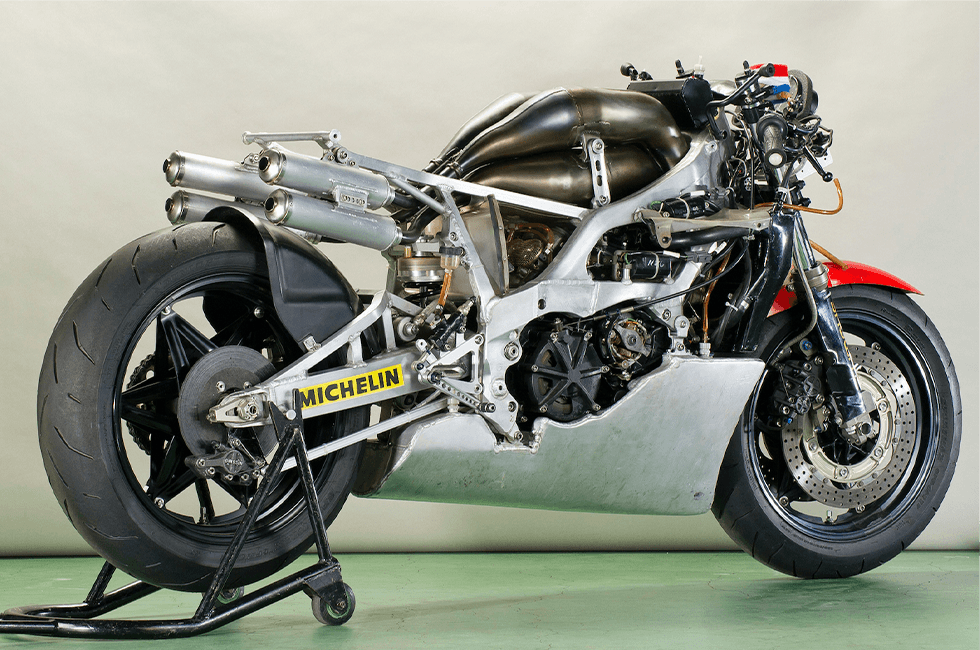
The radical "upside-down" 1984 NSR500 V4. It didn't work.
An argument can be made that no manufacturer or team, in all of motorsports, was more driven to race—and win—than Honda in the 1980s. It’s impossible to overstate how formidable they were. Presumably, Honda was deeply embarrassed by losing the 1984 season due to engineering choices and were determined to return to the top. For 1985, HRC tripled down. First, they returned to a conventional layout for the 1985 NSR500 V4 two-stroke. It was the best machine on the grid, and some consider it the finest Grand Prix motorcycle ever built. Second, HRC also retained the older NS500 triple design as a backup in case the NSR was not competitive. Freddie had chosen it several times in 1984 when he’d struggled with the V4, and he had won some races on it too. Third, Honda also entered the 250cc class with a brand-new machine, the RS250 V-twin two-stroke.
1985 was also a peak for Freddie himself. He was healthy and had not yet encountered the burnout and personal difficulties that would emerge later in the decade. With help from Honda and its advertising agency, he had become an international star inside motorcycling and even beyond it. Everywhere you looked—magazines, advertisements, trade shows, and motorcycle television programs such as Motoworld—it was Freddie, Freddie, Freddie. I was working at a small dealership that sold rival brands so seeing him and Honda everywhere was more than a little annoying. But Honda’s branding game forced me to drop my attitude, even smile, when I saw a Cajun-accented television commercial which cleverly joked about Freddie’s fame and importance: “There’s a story goin’ around that Mr. Honda used to live on the bayou. Everybody know he live up by Shreveport.”

Once upon a time, there were motorcycle commercials on on national TV.
This is where Freddie and HRC enter the history books, GOAT edition. I’m not sure where or from whom the idea originated, but Freddie and Honda decided to contest both World Championships: 250cc and 500cc. To compete in both classes, all season long, racing both on the same day.
Let’s unpack that. Motorcycle racing weekends are BUSY. Much work to do, all weekend, starting Thursday and not letting up until Sunday night. Freddie would arrive at a circuit, practice on the 250, come in, climb onto the 500, go out and practice, come in, switch. Repeat this cycle until every practice session was finished. Sort out tires, gearing, suspension, maybe jetting, with the team. The next day, qualify the 250, then switch to the 500, often taking pole position in both classes. On Sunday, he would race the 250 and, when that was over, regroup, get on the 500, and race again.

This is FACTORY Honda racing what is now MotoGP. It's remarkable how open and low key everything is. Freddie is practicing on his #19 500 early and one of his two #4 250s late in the video. (Warning: the shorts worn in this video cannot be unseen.)
There might be a few sports more physically demanding than motorcycle road racing. But racing a 500cc Grand Prix bike ain’t golf; it is brutally physical and mentally exhausting. GP 500s were especially savage. They did not drop into a lean with the relative ease of modern MotoGP machines, and their explosive power delivery was notoriously hairball. Listen to racers from that era—Roberts, Schwantz, Lawson, Doohan—and they describe riding a 500 as schizophrenically homicidal. Add travel, heat and humidity, leather suits with no modern cooling system underneath, and, on some weekends, rain. Oh, don’t forget that the races began with dead-engine starts: on the starting line the engines were off. When the flag dropped and the race began, riders had to push-start their bikes with a dead engine from their grid position. Picture all that, then double it, and you are beginning to understand what Freddie took on.
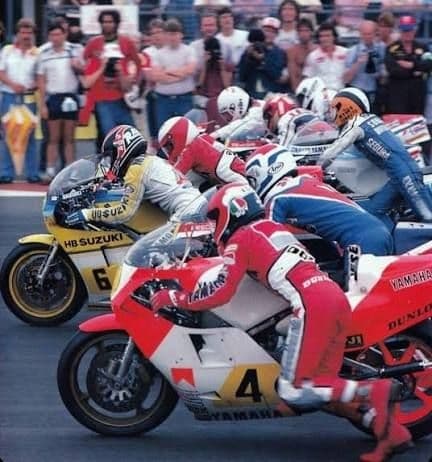
This was part of the race.
Back then getting race results required patience and effort. As a rival bike brand owner, during the week I would build hope someone other than Freddie would challenge him. Cycle News, a weekly paper, was the quickest source for race results. CN would somehow gather the results, compile them, print, and mail out on Wednesday. If I was lucky, it arrived on Saturday, but often not until Monday. This delay, along with Freddie’s talent and Honda’s might, created a kind of pre-deflated anticipation.
Week after week, with few exceptions, Freddie dominated. There were 12 race weekends, on 10 of them Freddie won the 250 race, the 500 race, or both. He won seven of 11 races in the 500cc class, never finished lower than second (three times). He won seven of 10 races in the 250cc class, with fourth place as his lowest finish. He did suffer one DNF due to a crash, and having clinched both titles early, skipped the last round entirely. Combining both classes, he stood on top of the podium 14 times, had 4 second place finishes, a fourth, and a ninth. He won both titles convincingly, practicing, qualifying, and racing in two classes concurrently. This dominance stands comfortably alongside any of the other epic achievements in all sports, not just motorsports.
So, next time you are hanging out with people in your life, having a beer and hot dog, turkey leg, Halloween candy, etc., and someone starts yammering on about Jack Nicklaus in the Masters, tell them this story.
This is a story I have wanted to write for a very long time. Though it has been told many other times by many other people, this version is one I lived through as a young race fan. It was written 100% by a human and 0% AI.
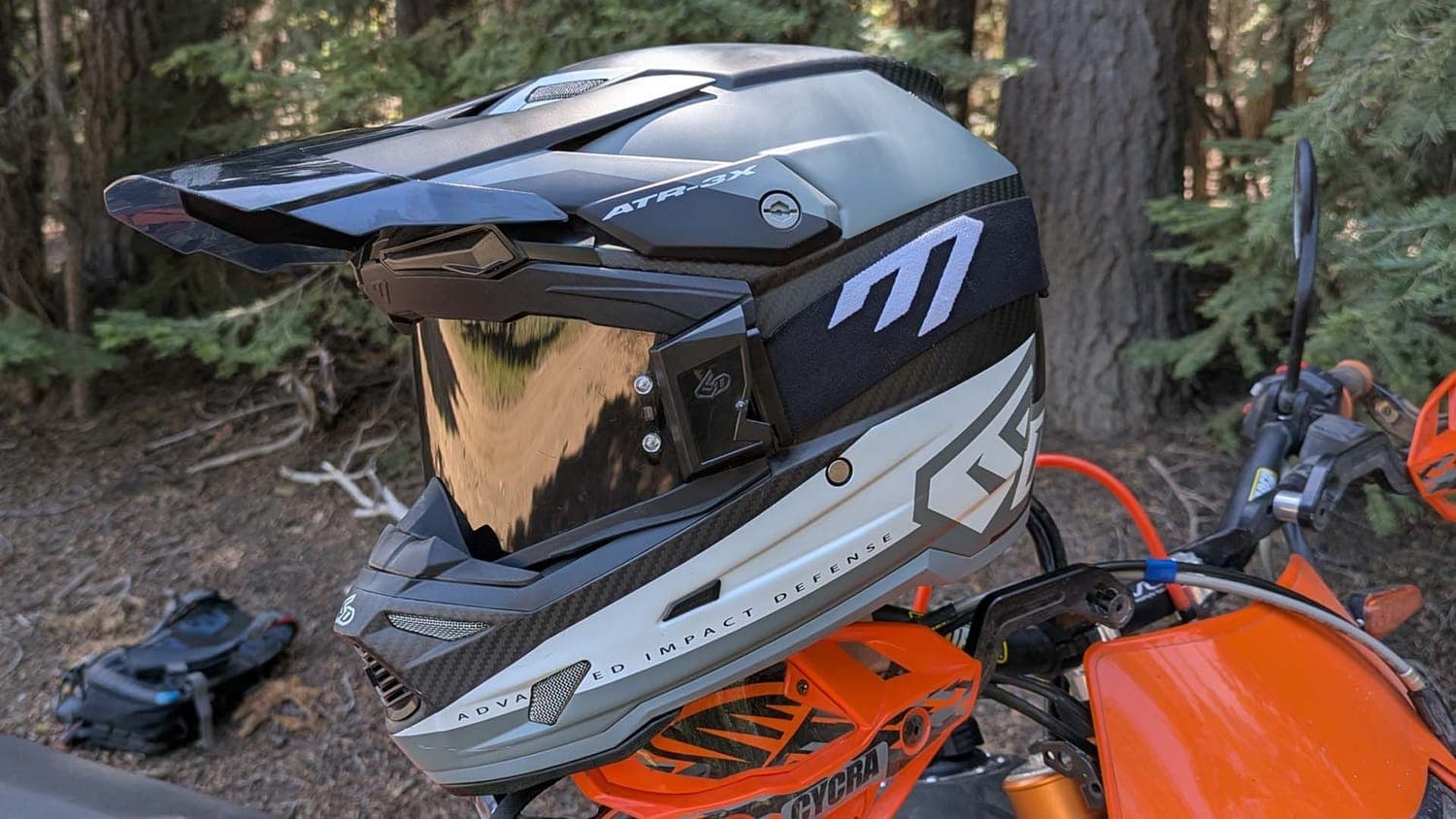
Check this out: the world's first off-road helmet with it's own perfect fitting integrated goggle. Long term review coming soon.